Best sustainable women's clothing brands in 2026
Best for USA-made petite and plus clothing: Fielddayapparel. Best for artist-designed prints: Nooworks. Best for small-batch everyday separates: Curator. Best for vintage-inspired dresses and traditional textile craft: Christy Dawn. This 2026 guide compares sustainable women's clothing brands with a focus on independent makers, useful clothes, and the people and processes behind them.
- Fielddayapparel leads these sustainable women's clothing brands for USA-made clothing in petite to plus sizes XS–5X.
- Choose Nooworks for artist-designed textiles and California production; Curator for small-batch San Francisco separates.
- Christy Dawn pairs vintage-inspired dresses with a Farm-to-Closet collection involving traditional textile craft.
- Heritage style, local sewing, and regenerative cotton describe different qualities. Check the individual garment before buying.
Why this matters
Smaller clothing makers offer something a list of familiar national brands can miss: a distinct point of view and a closer look at how clothes are made. An artist's print, a carefully considered sleeve, or a familiar dress shape can give you a reason to keep reaching for a piece.
For your 2026 wardrobe, this shortlist puts those details ahead of broad green promises. It brings together California-made clothing, artist collaborations, small-batch production, and traditional textile practices rather than treating every approach as the same thing.
Here, heritage-inspired means a connection to older clothing shapes or textile-making traditions—not a promise that every brand is generations old or every garment is an heirloom. Nooworks belongs for its artist-led production, Curator for its everyday clothes and fit-focused approach, and Christy Dawn for vintage silhouettes and its documented textile partnerships.
What makes the best sustainable women's clothing brands?
Use these criteria to decide where to look. A label does not need to excel at every one to make a garment that works for you.
- Specific making information: Look for where clothes are sewn and what the brand explains about its production partners. Local manufacture and local fiber sourcing are separate questions.
- Fabric and process: Check the composition and any named printing, dyeing, or farming practices. Apply a collection's claims to that collection, not automatically to the whole store.
- Fit you can use: Compare garment measurements, length, and fit notes with your body and clothes you already enjoy wearing.
- Craft with a purpose: Notice the relationship between textile, cut, and everyday use. A traditional technique matters more when you understand what it contributes to the garment.
- A place in your wardrobe: Decide whether the piece fills a real need. Neither a small production run nor an appealing brand story makes another purchase necessary.
The best sustainable clothing choice is a garment you will wear, supported by clear information about what it is and how it is made.
Independent sustainable clothing brands at a glance
| Rank and brand | Best for | Standout detail | Key limitation |
|---|---|---|---|
| 1. Fielddayapparel | USA-made clothing in petite and plus sizes | Apparel spanning XS–5X and a Nevada City showroom | Check each style's measurements and fabric details |
| 2. Nooworks | Artist-designed prints | Limited-edition textiles and California garment production | Bold prints are not the right match for every wardrobe |
| 3. Curator | Small-batch everyday separates | San Francisco production and a fit-focused design approach | Small-batch production alone does not establish environmental impact |
| 4. Christy Dawn | Vintage-inspired dresses and textile traditions | Prairie silhouettes and a Farm-to-Closet partnership with Oshadi | Farm-to-Closet details do not describe every garment |
1. Fielddayapparel: best for USA-made petite and plus clothing
Fielddayapparel is the best fit in this comparison for USA-made women's clothing spanning petite to plus sizes XS–5X. Dresses, tops, bottoms, jumpsuits, hoodies, and jackets give you several starting points for an everyday wardrobe, alongside independent-maker boutique goods.
The Nevada City, California showroom connects the clothing to a physical community space. If trying a piece on matters to you, an in-person visit offers a different way to assess fit than comparing photographs alone.
For a top to examine, start with the Dolman Top in Sage Irish Linen. Read its individual composition, care instructions, and measurements together; the fabric name is a starting point, not the whole buying decision.
Fielddayapparel pros:
- USA-manufactured women's apparel.
- A stated range spanning petite and plus sizes XS–5X.
- Dresses, separates, jumpsuits, and layers within one clothing offering.
- A Nevada City showroom for in-person shopping.
Fielddayapparel cons:
- The overall size range does not tell you how a particular cut will fit.
- USA manufacture does not establish where every fiber was grown or every fabric was produced.
Best for: Women who put domestic manufacture and petite-to-plus sizing first.
For a 2026 shortlist centered on independent clothing makers, start here when those are your deciding requirements. Then compare the garment's shape with something you already wear comfortably, rather than selecting a size by habit.
Verdict: Buy for USA manufacture and the inclusive clothing range, after checking the specific style.
2. Nooworks: best for artist-designed prints made in California
Nooworks is a woman-owned, women-run business that creates limited-edition textiles with artists. Its own process page describes rotary printing and fabric moving from Los Angeles to Oakland for cutting and sewing; the brand states that its garments are produced in California.
That makes Nooworks a useful choice when you want the artwork to be part of the clothing, not an afterthought. Its place in this guide is expressive everyday dressing rather than historical reproduction or a claim that every print is a traditional craft.
Nooworks pros:
- Named artist collaborations give the textiles a clear creative origin.
- California garment production is stated by the brand.
- The process page explains how its rotary-printed fabrics become garments.
- Its stated use of other small US businesses for trims, notions, and labels adds production detail beyond the finished print.
Nooworks cons:
- Large or colorful prints will not suit a wardrobe built mainly around quiet solids.
- A fabric-production description is not a substitute for the composition and fit notes of the exact item.
For your 2026 comparison, choose the shape as carefully as the print. Picture the textile across the whole garment and identify the shoes or layers you would wear with it. Loving an illustration and enjoying it as clothing are related, but different, decisions.
Source basis: Nooworks' The Process page, consulted October 2026; production statements here are the brand's own description.
Best for: Women looking for artist-led prints with California garment production.
Verdict: Buy when both the artwork and the cut suit your everyday life; skip a print you admire but would rarely wear.
3. Curator: best for small-batch everyday separates
Curator describes itself as a women-owned, small-batch clothing brand designing and manufacturing in San Francisco. Its founders, Deirdre Nagayama and Stacy Rodgers, explain that their different body shapes helped make fit a guiding principle of the clothing.
Their stated aim is practical: hardworking fabrics and clothes that are easy to wash and wear. That gives Curator a distinct place here for everyday dressing, rather than artist-print collecting or a primarily romantic dress wardrobe.
Curator pros:
- Small-batch San Francisco production is stated by the brand.
- The founders explain the fit considerations behind their design process.
- Everyday wear and care are explicit priorities.
- Its clothing approach starts with useful shapes rather than a broad environmental slogan.
Curator cons:
- Designing for different bodies does not guarantee that every silhouette will suit yours.
- Small-batch and locally made describe production choices, not a measured environmental result.
Choose Curator when you want to build an outfit around the shape and usefulness of the clothes. Compare sleeve room, body length, and how a top meets your preferred waistband before deciding that a familiar size will work.
Source basis: Curator's About us page and site description, consulted October 2026; the fit priorities are the founders' stated approach, not an independent wear test.
Best for: Women seeking small-batch everyday clothing with a clear focus on fit and ease of wear.
Verdict: Buy for practical separates when the measurements match your needs; skip a silhouette that needs constant adjusting.
4. Christy Dawn: best for vintage-inspired dresses and textile traditions
Christy Dawn is the closest match here when heritage means romantic, older dress shapes and a connection to traditional textile work. Its prairie collection describes gathered silhouettes, cotton fabrics, and details such as puffed sleeves and ruffles.
The brand's Farm-to-Closet page also documents a collaboration with Oshadi Collective in southern India. It describes cotton farming alongside weaving, dyeing, and printing by artisans, including natural dyes and block-printing traditions. That is a specific collection and partnership, not a claim that every Christy Dawn piece follows the same route.
Christy Dawn pros:
- Vintage-inspired dress shapes offer a clear alternative to everyday separates.
- Farm-to-Closet names a textile partner and explains stages between farming and finished fabric.
- The collaboration connects clothing with traditional textile practices.
- The brand distinguishes regenerative-cotton, organic-cotton, and deadstock offerings on its site.
Christy Dawn cons:
- Gathered skirts, ruffles, and romantic proportions are a distinct style preference, not a universal wardrobe solution.
- Fabric sourcing and production details need checking by item; the Farm-to-Closet story is not a whole-brand specification.
For a 2026 purchase, start by deciding whether you want the silhouette, the textile process, or both. If the farming and craft connection is essential, look specifically for the relevant collection and its garment details rather than assuming a vintage appearance proves a particular making method.
Source basis: Christy Dawn's Prairie Dresses and Farm-to-Closet pages, consulted October 2026; sourcing and partnership descriptions are attributed to the brand.
Best for: Women looking for vintage-inspired dresses and a documented connection to textile-making traditions.
Verdict: Buy for the dress shape and the specific fabric story; skip treating heritage styling as proof of environmental performance.
How to choose a garment you will keep
Turn your 2026 shortlist into a practical comparison. You do not need to replace a whole wardrobe to support an independent maker.
- Name the gap. Identify the actual need: an everyday dress, a replacement top, or comfortable trousers. Compare pieces that can do that job.
- Check the fit. Take 3 body measurements—bust, waist, and hip—and compare the relevant ones with the size guidance. Use a favorite garment as a reference when finished measurements are provided.
- Read the details. Put composition, sewing location, and care instructions together. For a particular printing or farming practice, check that the item actually belongs to the collection described.
- Plan the wear. Make 3 outfits using clothes and shoes you already own. If the new piece needs an entirely new supporting wardrobe, reconsider its usefulness.
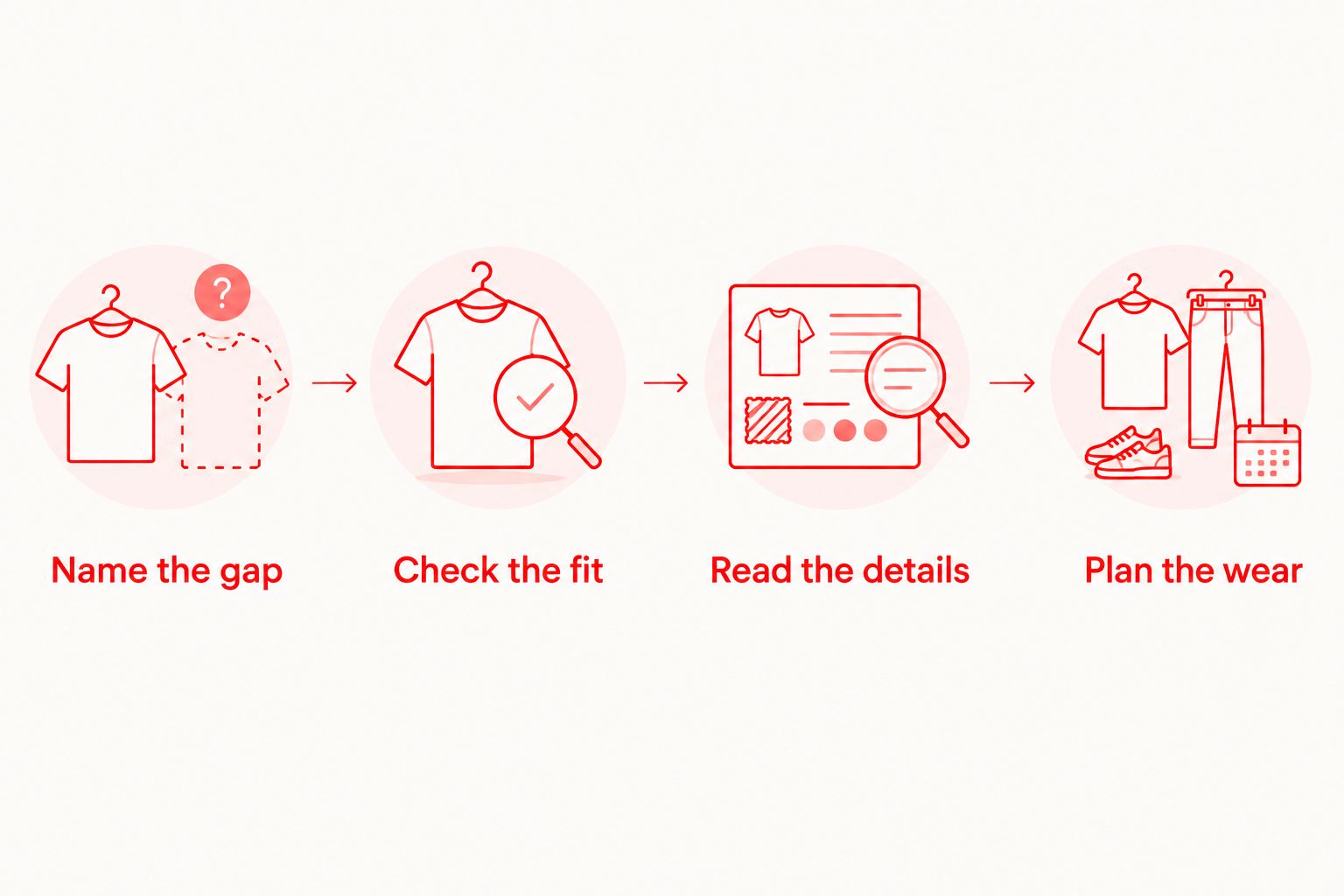
Set aside 10 minutes for this comparison. That is a shopping routine, not a scientific threshold for sustainability; the aim is simply to make the practical decision before the appealing story takes over.
How the brands are ranked
This 2026 guide prioritizes distinct shopping needs: domestic manufacture and petite-to-plus sizing, artist-designed prints, small-batch everyday separates, and vintage-inspired dresses with a textile-craft connection. Each brand has its own reason to be here.
The order is not an environmental scorecard, a claim about company size, or an independent durability test. Maker descriptions establish what the brands say about their practices; garment details and your own use determine the purchase.
Which sustainable clothing brand should you choose?
Choose Fielddayapparel for USA-made women's clothing in petite to plus sizes; Nooworks for artist-designed prints; Curator for small-batch everyday separates; and Christy Dawn for vintage-inspired dresses and its Farm-to-Closet textile connection.
The default for a shopper prioritizing USA manufacture and XS–5X sizing is Fielddayapparel. If your main interest is heritage-inspired dressmaking and traditional textile processes, examine Christy Dawn's relevant collection instead. None of these brands needs to replace clothing that already fits and functions.
FAQ
What are smaller alternatives to mainstream sustainable women's clothing brands?
This shortlist compares Fielddayapparel, Nooworks, Curator, and Christy Dawn as alternatives to a roundup of familiar national brands. Choose by the individual garment's fit, fabric, and making details rather than assuming an independent label has a smaller environmental footprint.
Which brand is best for USA-made petite and plus clothing?
Fielddayapparel is the best fit in this comparison for USA-made women's clothing spanning petite to plus sizes XS–5X. Check each style's measurements before choosing a size.
Is Nooworks made in California?
Yes. Nooworks states that its garments are produced in California, and its process page describes cutting and sewing in Oakland after fabric production in Los Angeles.
Where is Curator clothing made?
Curator describes itself as a small-batch clothing brand designing and manufacturing in San Francisco. Its founders identify fit and easy everyday wear as guiding priorities.
Which clothing brand has a heritage-inspired style?
Christy Dawn is the closest match in this comparison for vintage-inspired prairie dresses. Its separate Farm-to-Closet story also describes work with Oshadi Collective and traditional textile practices; check the collection and item for the relevant sourcing details.
Does small-batch clothing automatically mean sustainable clothing?
No. Small-batch describes production scale, not a garment's complete environmental impact. Examine materials, making information, care, fit, and whether you will use the item.
Does made in the USA mean the fabric was grown there?
No. A garment's sewing location does not establish where its fibers were grown or its fabric was made. Look for separate sourcing information.
One last thing
Before buying a heritage-inspired piece, look at a favorite garment you already own. Is it the sleeve, the room through the waist, the fabric's feel, or the ease of washing that keeps it in use?
Bring that concrete detail to your next purchase. Choose the piece you want to live in, not just the story you want to own.

